

Melanin provides some natural protection from ultraviolet radiation—but it does not make anyone immune to skin cancer.
People with Black, Hispanic, Asian, Mediterranean, Native American, Pacific Islander, and other darker skin tones can develop basal cell carcinoma, squamous cell carcinoma, and melanoma. One reason this matters is that skin cancer in darker skin may be recognized later, when treatment can be more difficult.
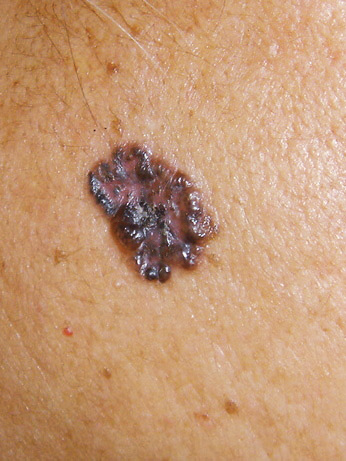
Q: Does skin cancer always appear on sun-exposed skin?
A: No. In darker skin tones, suspicious lesions can occur on the palms, soles, fingers, toes, around or under the nails, inside the mouth, and in other less sun-exposed locations. Skin cancer can still occur on the face, scalp, neck, and other sun-exposed areas as well.
Q: What should I look for?
A: Watch for a new or changing spot, a sore that does not heal, a growth that bleeds repeatedly, a rough or scaly patch that persists, or a lesion that changes in size, shape, color, or symptoms. Dark streaks in a nail deserve attention when they are new, changing, widening, or associated with pigment extending onto the surrounding skin.
Q: What about melanoma?
A: The ABCDEs—Asymmetry, Border irregularity, Color variation, Diameter, and Evolution—are useful, but “E” for evolution is especially important. Any lesion behaving differently from the rest of your spots deserves a closer look.
- Palms
- Soles
- Between fingers and toes
- Under and around nails
- Scalp
- Inside the mouth and on the lips
- Genital and buttock areas
Q: Does everyone need the same screening schedule?
A: No. There is no single skin-exam schedule that is right for everyone. Personal and family history, number and type of moles, prior skin cancer, immune suppression, sun exposure, and examination findings all influence how often professional skin checks may be appropriate.
The larger message is simple: skin cancer awareness should include every skin tone. If you see a lesion that is new, changing, bleeding, painful, or simply does not look right, have it evaluated.
Learn more about skin cancer care at Borealis Dermatology.
Borealis Dermatology sees patients in Garden City, Syosset, and Bellerose, NY. Visit our locations page or Book Appointment for a skin evaluation.
Continue reading about the ABCDEs of a changing mole.